
There are two very different moments in marketing.
Moment One: Someone is actively looking for what you sell.
Moment Two: Someone isn't looking for you yet — but could become interested if the right message appears.
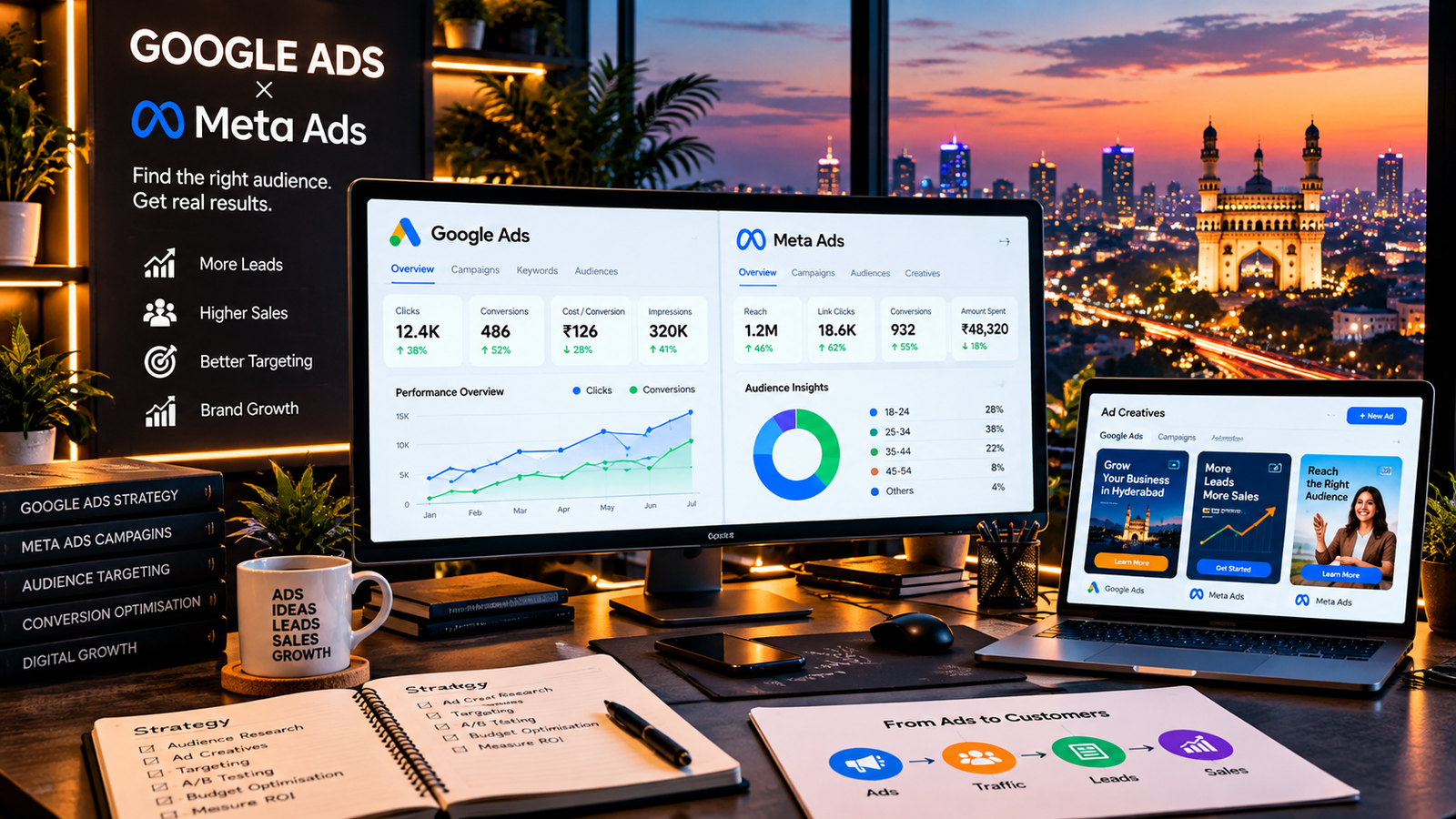
Google Ads can be exceptionally powerful in the first moment. Meta Ads can be exceptionally powerful in the second. And successful digital advertising often comes from understanding how the two work together.
Google Ads: Capture Existing Intent
Imagine someone searches: "3 BHK apartments in Hyderabad", "interior designers in Hyderabad", "digital marketing company near me", or "best banquet hall in Madhapur". That person has already expressed intent.
Google Ads allows advertisers to compete for visibility around relevant searches and other Google advertising surfaces. The opportunity is obvious: Be present when somebody is already looking.
But buying clicks isn't the same as buying customers. Keyword strategy, negative keywords, ad relevance, landing-page experience, tracking and ongoing optimisation all influence whether that traffic becomes commercially useful.
Meta Ads: Create and Capture Interest
Facebook and Instagram work differently. People usually aren't opening Instagram specifically to find an insurance provider or interior designer. They're consuming content.
That's why Meta advertising depends heavily on the ability to interrupt attention without feeling irrelevant. Creative becomes crucial. The photograph. The opening two seconds. The headline. The Reel. The offer. The audience. The landing experience. They all contribute to performance.
Google Ads vs Meta Ads: Which Is Better?
Neither. Or both. It depends.
Consider a high-intent service. Someone searching "corporate video production company Hyderabad" may be commercially valuable because they are actively looking for that service. Google Search Ads can capture that demand.
Now consider a new restaurant opening. Thousands of relevant customers nearby may not be searching for a new restaurant that exact day. An attractive Meta campaign can introduce it to them. That's demand creation.
Strong marketing frequently combines: Demand Generation → Demand Capture → Remarketing → Conversion.
What Makes Paid Advertising Work?
Running advertisements is easy. Running advertisements profitably is harder. Our approach considers five connected elements:
- Audience: Who should see the advertisement?
- Offer: Why should they care?
- Creative: What will make them stop?
- Destination: Where are we sending them?
- Measurement: What happened after they clicked?
If any one of those breaks, performance can suffer.
The Landing Page Matters
One of the biggest mistakes in paid advertising happens after the click. A great advertisement sends someone to a slow, confusing or generic webpage. The customer leaves.
Advertising therefore shouldn't be separated from website experience. Where necessary, campaign strategy should include dedicated landing pages built around the advertisement's specific promise. The journey becomes: Ad → Relevant Landing Page → Clear Offer → Trust → CTA → Conversion.
Creative Is Becoming a Performance Variable
The age of one advertisement running for six months is disappearing. Audiences fatigue. Formats change. Messages need testing. That makes continuous creative development important.
And this is one area where AASTHAA MEDIAVERSE's wider ecosystem becomes valuable. Because we work across ad films, Reels, content, branding, design and studio production, paid-media campaigns can have a continuous creative pipeline rather than depending on one static advertisement.
Google & Meta Advertising Services
- Google Search Ads
- Google Display campaigns
- YouTube advertising
- Remarketing
- Meta Facebook Ads
- Instagram Ads
- Lead-generation campaigns
- Website conversion campaigns
- Traffic campaigns
- Awareness campaigns
- E-commerce campaigns
- Retargeting
- Creative testing
- Landing-page strategy
- Conversion tracking
- Campaign optimisation
- Performance reporting