
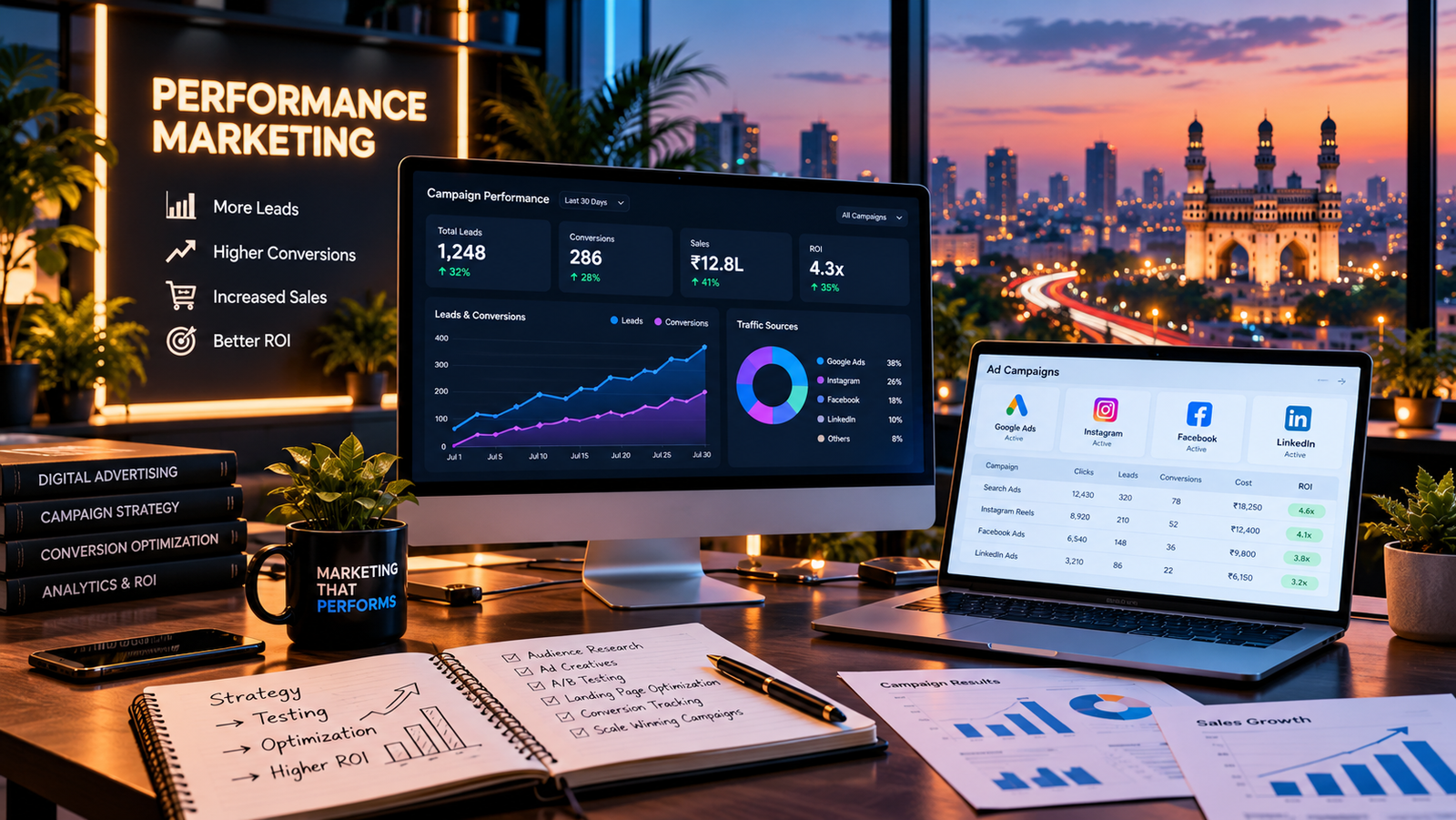
Marketing has always had a difficult question waiting at the end of the month. "What did we actually get from it?"
Likes? Views? Impressions? Followers? Those numbers can be useful. But businesses eventually need another set of numbers. Leads. Sales. Revenue. Cost per acquisition. Return on advertising spend.
That's where performance marketing enters the conversation.
What Is Performance Marketing?
Performance marketing is an approach to digital marketing in which campaigns are planned, measured and optimised around defined actions or business outcomes.
Those outcomes might include: Lead → Call → Registration → App Install → Booking → Purchase → Subscription
Rather than simply asking how many people saw an advertisement, performance marketers ask: What did people do after seeing it?
Performance Marketing Isn't Just Paid Ads
This distinction matters. Launching Meta Ads doesn't automatically mean you are doing performance marketing. Performance requires an ecosystem.
Media + Creative + Audience + Offer + Landing Page + Tracking + Analytics + Testing + Optimisation
All of those pieces influence the outcome. An advertisement might be excellent but lead to a terrible landing page. The campaign fails. Targeting might be perfect but the offer is weak. The campaign fails. The landing page converts beautifully but tracking is broken. The business doesn't know what worked.
The Funnel Matters
Consider a real-estate campaign: Advertisement → Landing Page → Enquiry → Sales Call → Site Visit → Booking.
If we measure only leads, we may conclude that Campaign A performed brilliantly. But suppose Campaign A generated 100 cheap leads and no bookings. Campaign B generated 30 more expensive leads and five bookings. Which performed better?
Clearly, the answer isn't hiding inside cost per lead alone. Good performance marketing tries to connect marketing metrics with actual business outcomes wherever the available data allows it.
Creative Is Part of Performance
Performance marketing has sometimes been treated as purely analytical. Numbers. Dashboards. Spreadsheets. Bid strategies. But someone still has to stop scrolling. That requires creativity.
The hook matters. The headline matters. The photograph matters. The first three seconds matter. The offer matters. Performance marketing therefore works best when creative thinking and analytical thinking operate together.
This is one reason our wider AASTHAA MEDIAVERSE structure matters. We can connect: Strategy + Content + Reels + Ad Films + Design + Media Buying + Landing Pages + Analytics rather than treating creative production as an external dependency.
Test. Learn. Improve.
Performance marketing rarely begins with the perfect advertisement. It improves through iteration. Different audiences, hooks, headlines, offers, creatives, formats, landing pages, and calls-to-action can be tested.
The objective isn't random experimentation. It's learning. What works? For whom? At what cost? And can it scale?
Important Performance Marketing Metrics
- CTR — Click-Through Rate: How frequently people click after seeing the advertisement.
- CPC — Cost Per Click: How much each click costs.
- CPL — Cost Per Lead: The average advertising cost of generating a lead.
- CPA — Cost Per Acquisition: How much it costs to acquire the defined customer/action.
- Conversion Rate: What percentage of visitors complete the intended action.
- ROAS — Return on Ad Spend: How much attributable revenue is generated relative to advertising expenditure.
But no metric should be viewed in isolation. Cheap leads that never become customers aren't necessarily a success.
Performance Marketing Services
- Performance strategy
- Funnel planning
- Google Ads
- Meta Ads
- Lead-generation campaigns
- Conversion campaigns
- E-commerce campaigns
- Remarketing
- Audience strategy
- Creative testing
- Landing-page strategy
- Conversion tracking
- Campaign optimisation
- Analytics and Reporting
- Scaling strategies